Sunday, December 6, 2015

Got myself a fauxpro - SJCam SJ400 review

I like taking video when I kayak. I am not sure why. Mostly I end up with large amounts a very boring video. I started with an Oregon Scientific ATC3K then I got and ATC9K. They no longer make the ATC9K. My wife has a GoPro Hero3 Black and I considered a GoPro but I could not justify the price for something I was using to amuse myself. If I wanted to make professional video then maybe. So I did some research and found the SJ400. It is interesting how many knockoffs there are of this knockoff. I got the WiFi version for $80 the non WiFi version runs around $65.

There are many good comparison reviews on the internet. Just do a search. These are my opinions based on how I will use the camera.

First looks compared to the GoPro Hero3 Black.


The GoPro and SJ4000 are plastic bodied small cameras. The GoPro lens is extended a little ferther from the body. Both have a power button on the front and the button  on top to start recording or tack still photos.


The SJ4000 comes with a bilt in view screen which the GoPro does not have.


The water proof cases are similar but the SJ4000 comes with the case a part of the base package as does the GoPro Black edition.


The SJ4000 also comes with a bunch of mounting attachments. You can also use any of the GoPro or after market GoPro mounts.

So, not a big difference in size, looks or mounting options.

        SJ4000                                                              GoPro Hero3 Black
  • Records Full HD 1080p30 Video                        Records 4Kp15 / 2.7Kp30 / 1440p48 / 1080p60 / 960p100 / 720p120 fps
  • Captures 12 MP Still Photos                                Captures 12MP/ 30 fps Burst
  • Ultra-Wide 170° Lens                                          Wide Angle Lens
  • Camera Housing Waterproof to 100'                   131’/40m Waterproof Housing
  • Wi-Fi Remote Monitoring and Control (App)     Wi-Fi Remote and App
  • On-Board 1.5" LCD Screen
  • Single Shot and Self-Timer Time Laps                 Time Lapse mode
  • USB Streaming Webcam Function
  • Multiple Mounts Included

Check out some of the side by side video comparisons on the web.

Now here are my takes on the camera.

Video quality is not bad. A little on the blue side but that has an adjustment I have not tried. It was designed as a dash cam first with a waterproof housing for motor cycles. The sound is not existent in the waterproof housing so I turned it off. I don't really need it. The housing works well. I like the lock better than the one on the GoPro. Easy to use. The battery life is only about 2 hours max, I think it is probably a little less. Has some neat features like video branding with the time stamp.Easy to configure. 

Here are some unedited video samples without the proper date set.


In the video below i Smacked the camera with my paddle and then dunked it in the water as a test. It worked just fine.


Rolling with the camera. This is after I set the date and branding.


Low light footage of the quiver. Looks good to me.


Overall review, sturdy camera in the case with decent video quality. The audio is non existent in the waterproof case. It comes with a second back with vents. This may improve audio but would not work for me. For the price I am very happy with the camera. I am disappointed by the battery life. It's not like you can change it on the water easily. It is easy to use and I can turn it on and off and start and stop recording with my 3mill mittens, that is a plus. It was made to be a dash cam and has features like clipping at intervals and writing over earlier clips when the card is full. 

If you are looking for an inexpensive camera it is worth checking out. Just beware of the knockoffs.

Friday, November 13, 2015

Novice in a rec boat in trouble and how he was helped.


On Sunday the 8th of November 2015, we had set out for a nice paddle on the Potomac. We launched from Belle Haven Marina and were going to head south a few miles and then paddle back. We paddled out of the mooring bay past the sail boats and out into the Potomac.

I was paddling my wife's NDK Surf, which I never get to do, so I was playing around and out ahead of the group going straight out. The rest of the group paddled at a south easterly angle past the pebble rock shoals that are exposed at low tide.

Conditions: The tied was going out and about 40 minutes from low slack. The winds were blowing around 10 MPH and the skies were clear. The water temperature was around 59 degrees and that air temp was in the high 50's and would settle in the low 60's.

I hear my wife call out that she sees someone on one of the shoals and there was debate in the group if it was someone in trouble. My wife says she is going to check it out. I am a little ways from the group but I turn to rejoin them.

In the link below you can read my wife's write up on what followed:

The lorax's Wife incident report from the paddle on November 8, 2015.

So, hopefully you read her report. What follows is my report. It will be judging but every event has to be looked at with an eye on how could it have been done better. The person I am going to be harsh on is mostly myself.

The group arrived at the scene a minute or two before I did and my wife was calling to the guy in the rock shoal from the north side. I came up from the south side and could hear the guy (from here on out to be know as the victim) sobbing. I am out of my boat and on the shoal beside the guy calling out to him while everyone else is still in their boats. My wife has sent someone to the marina since we are so close and ask a member of the group to retrieve the victims kayak which we see about a hundred feet away by the island that the shoals have formed around.

Here is where I get critical. My wife is giving me orders and I got irritated. My short coming. She had stepped up as the lead but I am capable in my own right. My ego could have caused problems if I had not realized how this needed to play out. I was also irritated that I was the last to the scene but the first to the victim. (This was my personal emotion, in a situation like this people need to remain in their comfort zone.) This is because I tend to react and studied the scene as I approached. I also approached from the rear left announcing my presence and came into the victims view before reaching out to touch him. This was for my safety in case there was ill intent on his part. Stay out of the victims striking range while you assess the situation.

Okay, the victim is conscious but not responding to us. He is sobbing and was obviously cold and not shivering and his skin was pale. Hypothermia!

My wife is on the radio with the coast guard and someone is on the way to get help from the marina. Someone has joined me on the shoal. I do not vocalize my plan and leave the victim to get my emergency kit. The other person on the shoal does the same leaving the victim un-monitored. This is my fault. I should have said what I was doing and asked the other person to stay with the victim. When I got back in about 20 seconds with my kit the victim was laying on the ground but still sobbing. We get the emergency blanket around him as best we could. Had help not been just minutes away I had a ground cloth to move the victim onto.

Moments later the skiff from the marina arrived with the guy the victim had been out kayaking with. We get the victim up and onto the skiff while I am getting irritated with his "friend" who starts fussing with the kayak. The skiff pilot and I both yell at him to leave the kayak and get into the skiff. As I push them off I tell them I will tow the kayak over.

My wife informs the coast guard what is transpiring. Their ETA from the start of the request for help was 6 minutes. The skiff was on its way and I was halfway to the marina towing the victims kayak as the coast guard paused on the other side of the river turning off its lights. My wife said she was watching the time and it was exactly 6 minutes when the coast guard arrived. As I pulled up to the kayak launch with the victims kayak the EMTs were arriving at the marina.

From the time we arrived the victim was in the hands of definitive care in around 10 minutes. My wife and everyone in our group performed great. I have issues with some things about myself and I tend to place the same expectations I have for myself on others, Not a great personality trait.

Speculation time!!!! So, how did this situation happen?

My theory is based off different pieces of information I gathered during the crisis and from the guy from the marina kayak shack.

First the two guys left together. The victim had never kayaked before as stated by his friend that morning while talking to the guy at the kayak shack. The friend who went with the victim that morning and arrived on the skiff for the extraction had been back at the marina for at least a half an hour. The victim is not wearing shoes, they are in the kayak.

They had to paddle against the wind and current to get back and the tide was dropping and the wind was blowing slightly toward the shoals and the island they formed around.

The new paddler in his bath tub shaped 8 foot boat has gotten tired and is paddling inefficiently and is blown onto the shoals. His friend has paddled away ahead of him and does not notice. The guy takes off his shoes and gets out to get the kayak off the shoals. He is first shocked by the coldness of the water and the slippery rocks and falls down letting go of the boat. The boat now not weighted by the paddler blows out of reach. The paddler carries his paddle to the highest point. Probably called out to his friend who did not hear him. Other people kayaking passed him but he did not call out. Hypothermia can happen rapidly and he was in light cotton pants and a cotton hoodie. Not appropriate dress for the water, especially in cooler weather.

We are just glad there was not a headline of "Kayaker Dies on the Potomac". Paddling around i a rec kayak does not make you a kayaker. You are a rec boater. I always hated when they would report "Rock Climber Falls at Great Falls" and it turns out it was someone with no equipment or experience climbing around on the rocks.

Okay, story over.

Monday, September 7, 2015

Chaptico Wharf to Newtowne Neck State Park

On Saturday September, 5 2015 the wife and I joined a group of CPA paddlers in a trip around Coltons Point, MD. This is part of a series of trips being lead by Ralph H. to help plan a water trail down the Potomac. He has been contacting both the Virginia and Maryland park services and working to get paddle up camp sites established. This was the 6th leg of the trip. My experience on this trip was very positive.

This is Ralph's original trip itinerary for the paddle series he has dubbed Potomac Passage Maker Tour. http://aceheimlich.com/CPA/Potomac%20Passage%20Maker%20Tour%20Preliminary%20Itinerary%202_4_2015.pdf

The weather report for the trip was good but the winds were predicted to be 10 to 15 with gust up to 20. We lucked out because the winds were not that strong on the water and at our lunch break I check the NOAA station and the winds were 7 to 9. That made it a pleasant and easy day on the water.

The only truly exciting part was the pair of large fish, possibly sharks, that we startled half way into Breton Bay. They bolted between my kayak and Tim's kayak. They were about 6 feet I would guess. A bull shark was just caught in that area on Thursday September 3rd. See the pictures here, http://wjla.com/news/local/photos-8-foot-bull-shark-caught-near-coltons-point-in-maryland 

After the paddle we went to Fitzie's for a nice seafood dinner then shuttling people and boats back to their cars. 

Now the track and some photos of the trip.


Getting ready to put in at Chaptico Wharf

The Lorax's Wife


Our host Ralph H.


Our fleet on the beach at St. Clements Island

Lunch by the lighthouse


The group as they leave me behind. Heading into Breton Bay.

Online Resources to Plan Your Next Kayak Outing

So, you are planning that next kayak trip. This is longer than just paddling a couple miles along the shore in your usual location. You want to plan your route but you do not have all the cool and expensive mapping software. Where do you start?

First you may want a chart of the area to print out and have with you. All the NOAA charts are available free online in PDF Format.

 http://www.charts.noaa.gov/InteractiveCatalog/nrnc.shtml

There is also an online chart viewer that can be used to plan your route and export it to your GPS.

http://earthnc.com/chartviewer/

Play around with this site and see all the information is has to offer.

Next you need to plan and know what to expect from the tides, currents and weather. I personally turn to NOAA for this information also. Other sites have this information but their data source is NOAA.

Tides and Currents
https://tidesandcurrents.noaa.gov/products.html

This site is not as user friendly as one would hope but if you poke around for a bit you will find it has all the information you want. It has loads of data including graphs of water temperatures, currents and wave averages over time.

Another place for tide information is http://tbone.biol.sc.edu/tide/

Then there is the National Weather Service provided by NOAA. I like to get and hour by hour report in tabular format and include wave prediction.

http://www.nws.noaa.gov/om/marine/home.htm


Then there is the information available from the buoy stations. http://www.ndbc.noaa.gov/


The National Data Buoy Center is a great resource for wind, waves and water temperature. You can also reach this site from the forecast page in the NWS Marine forecast page.

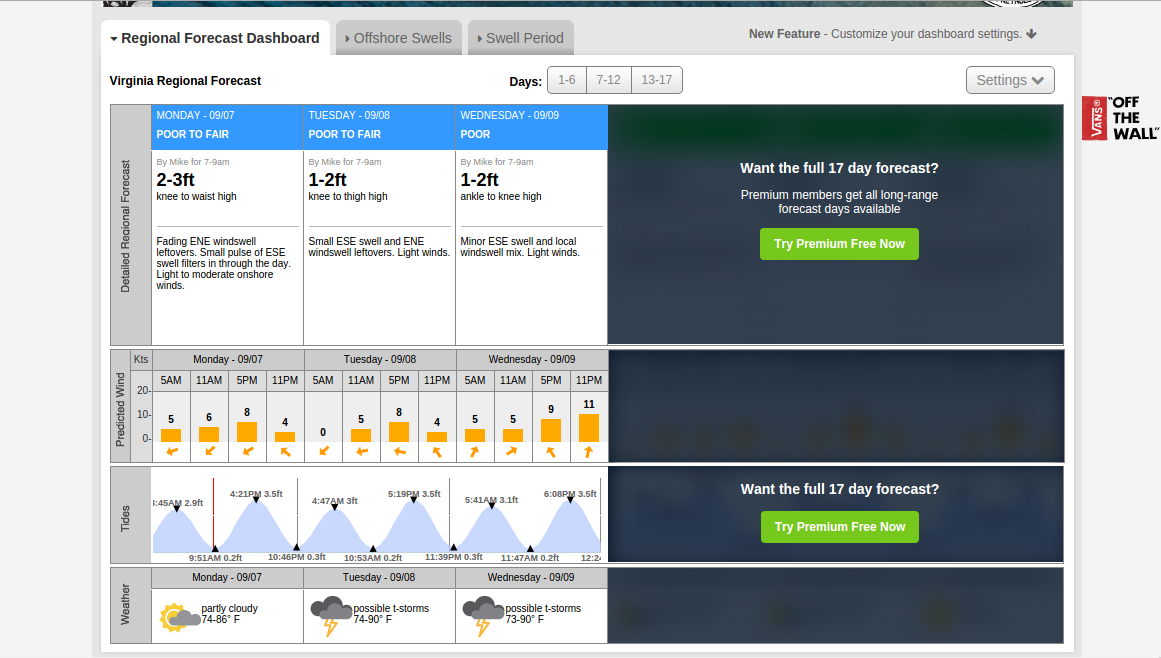
You will also want wave and surf information if you are paddling near the mouth of a bay or in the ocean. These are two sites I like to use.

http://www.surfline.com/


http://www.stormsurf.com/


Click around on StormSurf because it contains a lot of data. In the image above you can see the link tabs above the graphic, these will change the display map to show you all kinds fo data about the area.

Next you will want to have a float plan that you give to a family member or friend in the event you do not arrive back when you are expected.

Here are links to some example float plans.

http://floatplancentral.cgaux.org/
http://www.exploreri.org/documents/float_plan-seakayakermag.pdf
http://www.nps.gov/calo/planyourvisit/upload/Canoe-and-Kayak-Float-Plan_rev04-13.pdf

You should find one that works for you and make filing a float plan a habit even on short trips.

To make life even easier in this age of technology you can file a float plan from your smart phone.

 Float Plan Apps
http://www.uscg.mil/mobile/
http://www.americancanoe.org/?page=PaddleReady
http://www.thefloatplanapp.com/  - Android version still under development

And just a nice general reference for all things sea kayaking you might want to check out the "Online Sea Kayaking Referance Book"

Hopefully you find som of these sites useful. Pleas share your favorite kayaking trip prep sites in the comments.

Saturday, August 29, 2015

Leesylvania to Mallows Bay

So, I am late posting about this trip. There is not much to say. It was an 10.7 mile round trip paddle to Mallows Bay and back form Leesylvania State Park, VA.

The Ghost Fleet of Mallows Bay

So, here is the track and some photos of the trip.


Friday, August 28, 2015

The certification crisis. Is certification necessary?

We all know that the popularity of sea kayaking and expedition kayaking is waning. There is much debate about why this is happening. And like everyone else, I have my theories and opinions. First is elitists and safety wonks that populate the clubs and believe they are the only one that know how to kayak. The second is the rampant growth and push towards certification. Or maybe the ease and low entry of SUP.

I believe that there is much you need to learn as you advance to open water kayaking. I have always been the kind of guy who jumps in with both feet and will learn what I need to know through experience. I believe that most kayakers should learn this way. In my opinion this kind of learning will stick with you. Experiential learning is one of the best forms and I don't mean see then do method of teaching. Get a boat, life vest and paddle and go for it. That is how the first kayakers did it.
Now don't get me wrong certification is not a bad thing in and of itself. But just to kayak you do not need certification. I became an instructor for a good reason, my wife wanted me to do it. With assessments based on a standard scale you can judge if a person should be capable of a given paddle. Yet, there are clubs that have there own courses and if you take their course then you are golden whether you actually absorbed the knowledge or not. So maybe a standardized assessment is not a bad thing. Hard call.

If you paddle in a reservoir or a calm lake or a slow moving stream, chances are you do not need classes and certification. Now this is assuming you are not a dumb ass and use common sense. Lets face it, you can not protect people from themselves.

So, I was going somewhere with this. Now where was I going?

Oh, I remember. Elitists and safety wonks and certification. With clubs you meet all kinds of people and like any group there are those that can do, those that talk, those that judge and then there are the people having fun. It just appears that in these clubs there are a vocal few that think they know all about safety and they set stupid rules and basically drive the fun people away. It happens in all groups not just kayaking.

With our club my standard for people is, be able to get in your boat have an idea of how to paddle straight and wear your PFD properly at all times on the water. Now lets paddle and see the wildlife. If the leader and assistants have some assisted rescue skills and you lead with common sense it will be a safe fun trip. Some clubs harp on wearing a spray deck. Really? I am not taking a club paddle into 2 foot waves, that is for vetted peer paddles.

Lets not get bogged down with rules that don't make sense. The first group I paddled with had a must have list of equipment to paddle with them, including a throw bag, for flat water paddles.

Lost my way again. Can't keep my train of thought from derailing.

People want to paddle with other people. So, they join clubs and are met with elitists and rules that make no sense so they quit the sport. Or they are told they need this class or that class and quit. All they really need is a kayak, paddle, PFD and water appropriate clothing. The rest will come. If they enjoy what they are doing they will want to learn and improve or just stay at the level they are and enjoy the water. And both are acceptable paths as far as I am concerned.

So, in conclusion don't be a safety wonk and don't push the certification nonsense. People will learn at their pace in the way they choose and to an extent they choose. Wow, that was a long road to say so little.

Certification is not killing the sport. The business of certification might. Forcing certification to buy or rent a kayak will kill it. I think like everything else the over obsessed safety culture has created a generation of risk adverse people. That my have contributed to the decline. And the elitists and safety wonks are taking the fun out of it. Not all perceived dangers are valid dangers. Lets let people enjoy kayaking and learn as they go. Don't push certification or enforce rules and equipment requirements that are just not needed.

Oh wait.... I was at an end. OK, I am stopping now.

Tuesday, May 26, 2015

My Vegvísir patch. Now I will never get lost.

I finally sewed my Vegvísir patch onto one of my PFDs. If you know me at all you know that I studied Norse and early Germanic mythology and I thought this was kind of fitting for a PFD. My wife bought the patch for me.

The Vegvísir is also known as the Viking or Icelandic compass. 

The symbol is attested in the Huld Manuscript, collected in Iceland by Geir Vigfusson in 1860 (but consisting of material of earlier origin). A leaf of the manuscript provides a drawing of the Vegvísir symbol, giving its name, and, in prose, declaring that "if this sign is carried, one will never lose one's way in storms or bad weather, even when the way is not known".

It is said to be associated to Ægir.
In Norse mythology, Ægir (Old Norse "sea") is a sea jötunn associated with the ocean. The Jötnar are a mythological race that live in Jötunheimr, one of the nine worlds of Norse cosmology.